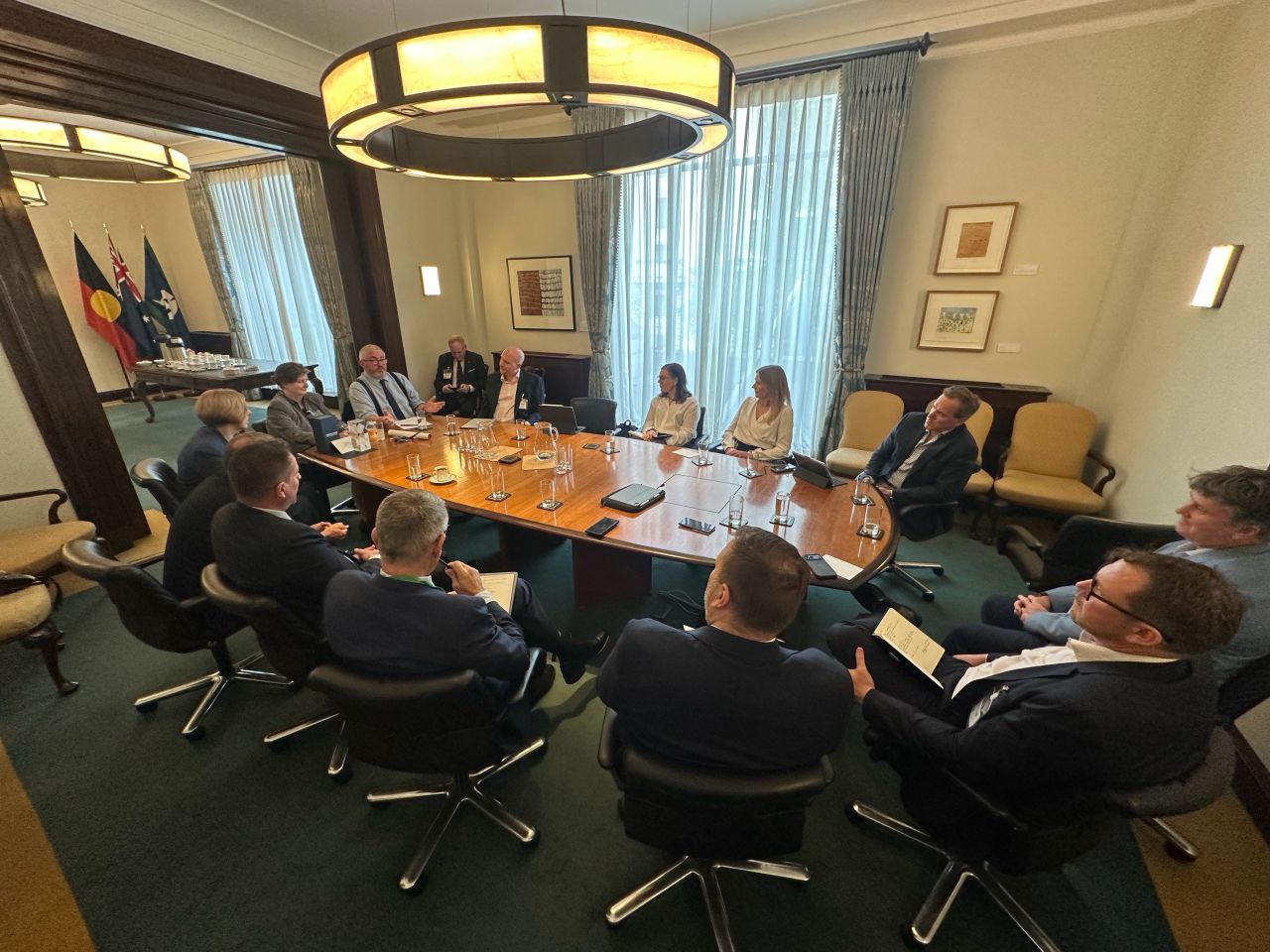
The inaugural Certa Cito Foundation Roundtable, held at Australia House with the support of the Australian High Commission, brought together Royal Australian Corps of Signals and defence-industry representatives from Australia and the United Kingdom. In a session presented by Toby Jones, the discussion turned on a single proposition: the challenge today is not inventing technology, but adapting it faster than the threat adapts.
Adaptation beats optimisation
For much of the modern era, defence has pursued capability superiority — fielding the best system and optimising it over a long service life. The roundtable's argument was that the decisive measure is shifting toward adaptation superiority: whether a force can observe change, update its systems and field capability improvements faster than an adversary. On that logic, a good capability that evolves rapidly can out-perform a perfect capability that takes years to change.
Designing systems for change
If adaptation is the goal, it has to be designed in. The systems that endure, participants noted, will not necessarily be the best on day one — they will be the easiest to evolve. In practice that means modularity, open interfaces, software-defined functions, clear upgrade pathways and integration flexibility, so that platforms can absorb change rather than resist it.
Lowering the cost of experimentation
Innovation, the discussion suggested, is rarely limited by ideas; it is limited by the cost and effort of proving them. Faster prototyping, easier experimentation, access to realistic environments and quicker user feedback all shorten the loop from concept to operational advantage — the quicker a force can test, fail, learn and adapt, the quicker it generates an edge. That, in turn, puts pressure on assurance: the old build–test–certify–deploy model has to make room for a continuous cycle of update, patch, reconfigure and redeploy. The task is not to choose between assurance and agility, but to make assurance agile enough to keep pace with operational reality.
The real constraint is people
Technology now changes faster than expertise can be grown. It takes years to develop RF engineers, electronic-warfare specialists, systems engineers and cyber operators — and by the time they are fully competent, much of the technology has already moved on. The strategic advantage, the roundtable concluded, increasingly lies in the ability to continuously develop people, not simply to continuously buy equipment. It is a theme that sits at the heart of the Certa Cito Foundation's own mission to Care, Connect and Commemorate across the Signals community.
ADT's perspective: sovereignty as responsiveness
As a sovereign Australian defence-technology company and a participant in the roundtable, Advanced Design Technology (ADT) takes a particular view of what sovereign capability is for. In ADT's framing, sovereignty is not primarily about where something was built — it is about responsiveness. When a system fails in the field, the engineer who designed it can answer the phone; the capability can be modified quickly; and feedback from operators can reach designers without layers of bureaucracy. Sovereignty, in other words, shortens both the decision loop and the support loop.
That is also why ADT argues the health of the specialist small-and-medium enterprise (SME) base is a strategic question, not merely an economic one. Many of the most innovative capabilities originate with specialist SMEs; the real test is how quickly Defence can absorb and operationalise that innovation. A diverse industrial base is, on this view, a form of resilience. ADT's own work — in electronic warfare, cyber-secure computing and communications — is built around exactly these principles: modular, upgradeable systems designed and supported in Australia, close to the operator.
"Maintaining the tactical edge is becoming less about owning technology and more about maintaining the ability to adapt technology faster than our adversaries can adapt theirs." — Adrian Thearle, Managing Director, ADT
Keeping the burden off the operator
A final thread ran beneath the rest. The tactical edge is growing more complex — multiple networks, multiple security domains, coalition environments, sensor fusion and AI-enabled tools — and that complexity has to be carried by infrastructure, not by the operator. The technology burden should never become a cognitive burden. For a company whose secure computing exists to let operators work across classified networks from a single, trusted workstation, it is a principle that maps directly onto the product.